Out of the three ancient parishes that comprise the Sid Valley, Sidbury is by far the largest, covering 6766 acres. It is also the most ancient settlement in the valley being perhaps one of the three original Saxon settlements in East Devon, along with Colyton and Woodbury. Having been in the ownership of Exeter Cathedral from before the Norman Conquest until the 19th Century, it s history is less outward looking than that of Sidmouth, but is well documented in the Cathedral records. Unlike Sidmouth and Salcombe Regis, no historian has gone through the records and made transcripts, though Medley (see references) makes extensive quotes from the original documents in his History.
The origins of human settlement in the Sid Valley are distant and indistinct. There is evidence from Neolithic tools of the third millennium BC, but settlement begins to come into focus in the Bronze Age about 1500 BC when many round barrows were built over the burials of important people. Peter Orlando Hutchinson (POH) identifies 78 such mounds in his History of Sidmouth, with more than half situated in a cluster known as the Farway Necropolis around the boundary between Sidbury and Farway parishes to the northeast of Putts Corner on the road to Honiton.
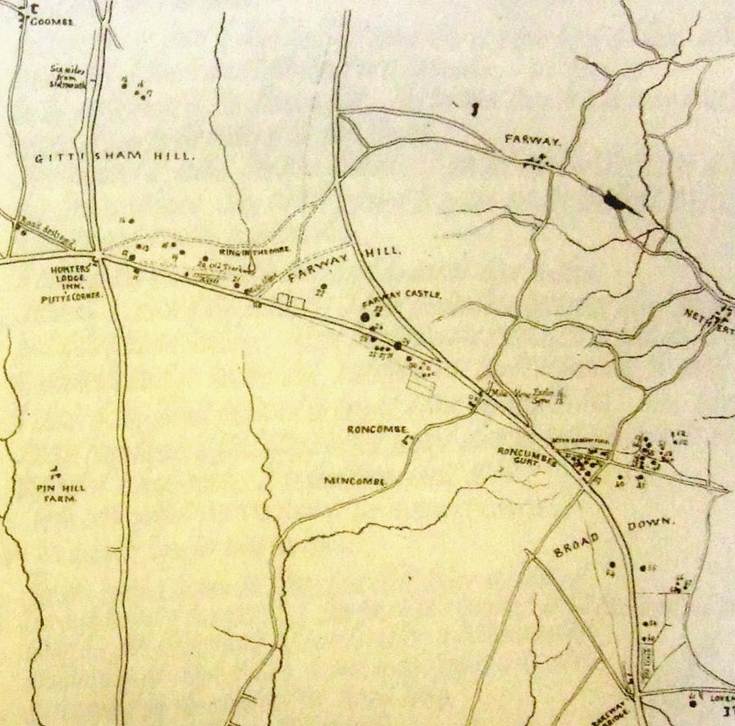
POH's map of the Bronze Age barrows in the Farway Necropolis
The bronze age residents were displaced by the Celts who used iron weapons and implements and fortified several hilltops in East Devon including Sidbury Castle , probably around 200BC. POH records the finding of a stash of beach pebbles on the castle that had evidently been stored for use as sling stones.
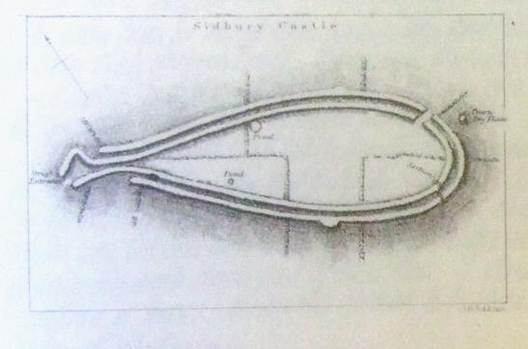
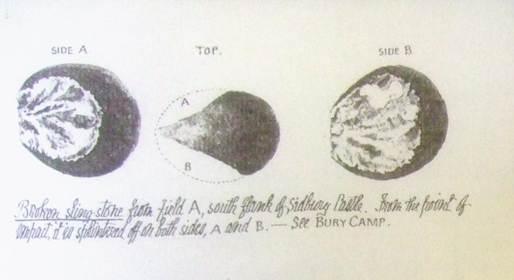
POH s sketch map of Sidbury Castle and of the sling stones found there
There is no evidence of Roman occupation of the Sid Valley, but plenty of evidence that Romans frequented the valley in this period. The A3052, High Street is a Roman Road and there were Roman villas at Woodbury and at Seaton.
Sidbury Village dates from very soon after the Saxon advance into Devon in the middle of the 7th Century. The original church would have been built of wood over a stone crypt which remains and was rediscovered in the 19th Century. In 937 the manor of Sidbury was given by King thelred to the monastery of St Mary and St Peter at Exeter which subsequently became Exeter Cathedral. At this time, Sidbury was probably the only village in the valley where a weekly market and fairs were held. These continued until recent times and the annual fair is still an important community occasion. Some Saxon coins, minted in Sidbury are kept by Copenhagen museum. The original Saxon farmsteads were at Sidbury village, Burnt Oak, Sand, Manstone and Hitways. By the time the Domesday survey was made, most of the lower valley slopes were leased to farmsteads.
At the Norman Conquest, the parish was occupied by 39 families of whom most were farmers living in farmsteads and leasing their land from the Cathedral authorities. The church was rebuilt in stone and modified several times in the 12th-15th Centuries. In his History, Medley quotes from several of the documents in the Cathedral archives collection for Sidbury indicating that a fairly complete record is kept. An early document is a church inventory from 1281.
One of the most colourful characters in Sidbury history is the Rev d Richard Babington who was vicar from 1626 to 1643. He became vicar when his father-in-law, John Bury, resigned in his favour, probably in order to install Richard, who was known to have non-conformist views, in a relatively safe and remote parish. During his incumbency, he arranged that his non-conformist parishioners could worship (perhaps in a house) and stretched the limits of his own services. In 1642 he was criticised for not saying the Epistle & Gospel in the manner required, and subsequently warned his friends not to appear in person if summoned but to send an attorney. The following year, he resigned on account of ill health, and in favour of his brother-in-law William Banckes who was subsequently sacked during the Commonwealth when caught teaching card games to children. His place was taken by Simon Parsons, who successfully navigated the Restoration. However, Babington remained and died in 1682, when he left £100 to 10 ejected ministers and was carried to his grave in the church by three conformists and three non-conformists, according to his express wishes.
Following the restoration of Charles II, a series of Acts were passed restricting religious freedom: the 1661 Corporation Act excluded nonconformists from public office; the 1662 Act of Uniformity made the Book of Common Prayer compulsory; the 1664 Conventicle Act forbade non-conformist religious assemblies of more than five people; and the 1665 Five-Mile Act forbade clergymen from preaching within 5 miles of a parish from which they had been expelled. Sometime during a period of persecution of non-conformists, a chapel was built at Sandcombe Farm above Sand. Matthews (see references at end) places building of the chapel in 1665, following the 5-mile Act. Softly (see references) suggests it may date to the earlier persecution in the 1640s. Either way it seems likely that the Rev d Richard Babington had a hand in it.
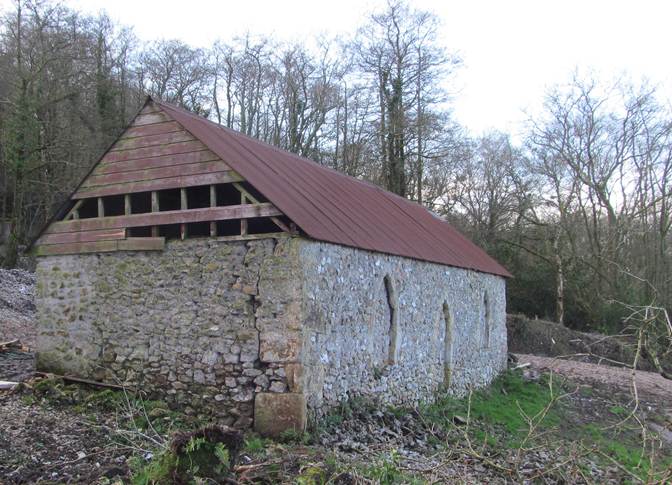
Sandcombe Chapel today, used as a barn, but still with its big gothic windows
There are several interesting buildings in Sidbury parish, the most significant of which is Sand. This was recorded as a copyhold estate of half a hide in Domesday (a hide was an area of land that could support a family and its retainers). The oldest existing building in the grounds is a 15th Century Medieval Hall House with a cruck roof. The manor house was bought by the Huyshe family in the mid-16th Century following which it was extensively remodelled from a Tudor L-shaped house into an Elizabethan E-shaped house. It has Jacobean fittings with a screens passage dividing the downstairs rooms. From the early 17th Century, the estate was let to farmers, but the house was refurbished in 1909 and taken back for their occupation by the Huyshes in 1967. It is not open to the public.
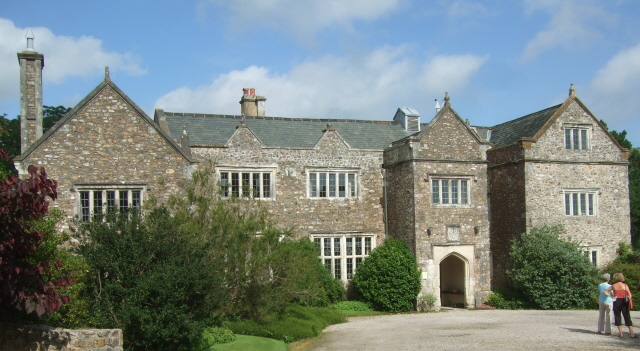
Sand the West Front
Porch House, in Sidford, has a date of 1574 and was originally the farmhouse of a substantial land holding, owned by Sidmouth Manor for many years. There is a legend that Charles II stayed a night there during his flight to France after the Battle of Worcester in 1651.
Manstone, also in Sidford, dates from the same period. It has an inscription H.M.1589, which is believed to refer to Henry Morgan who married Elizabeth, daughter of Richard Duke of Otterton. Henry died in 1646 leaving everything to her. She remarried Christopher Isaac, a widower of Sidbury, who died in 1669 leaving everything at Manson to her. The hall and solar have survived, but the north wing was demolished in the 19th Century. The houses in School Street, Sidford date from 1636 and Court Hall in the centre of Sidbury village, is an Elizabethan house with Georgian additions.
Sidbury Manor was owned by the Cathedral until 1801 when it was sold to the Guppy family who resided at Castle Hill. Ownership passed through several hands until the Cave family bought it in 1853. In 1878, they built the manor house that we see today.
Chelson is an outlying farm on the east side of the parish, which was the subject of disputed ownership by Salcombe and Sidbury. An initial investigation by a Mr Barnes concluded that it belonged to Sidbury, but when further documents came to light, he decided that an owner could not be identified for either Chelson or Sweetcombe. A compromise was eventually reached with Salcombe taking Chelson and Sidbury taking Sweetcombe.
At the time of Domesday, there were at least two mills on the River Sid in Sidbury parish: one in Sidbury village and one in Sidford. The mill in the village has been returned to working order. In early records it was described as two mills in one building.
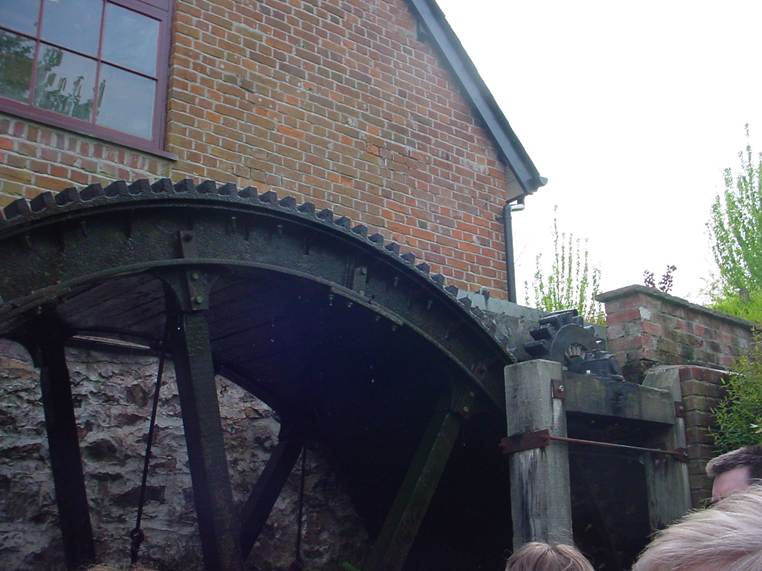
The refurbished mill in Sidbury village
References
- Medley, 1980, A history of Sidbury
- Matthews, 1997, It s nice to know Sidbury
- Softly, 2000, Sidbury s Church of a Thousand Years
- Huyshe/Huyshe-Shires, 2007, Sand: A short history
- Softly, 2009, Within the Bounds: Sidbury Parish past & present

